


Tsaaro got CERT-IN Empanelled | MeitY has published the DPDP Rules, 2023.
Tsaaro got CERT-IN Empanelled | MeitY has published the DPDP Rules, 2023.
Tsaaro got CERT-IN Empanelled | MeitY has published the DPDP Rules, 2023.
Tsaaro got CERT-IN Empanelled | MeitY has published the DPDP Rules, 2023.

Back To Home
Research Team (Tsaaro)
Data Privacy Day 2026 Highlights Growing Need for Trust as India Pushes Responsible AI

Overview:
As the world marks Data Privacy Day 2026, the spotlight turns to the growing importance of protecting personal information in an increasingly digital and AI-driven society. From everyday online activities to large-scale artificial intelligence systems, data now sits at the centre of trust among users, companies, and governments. This year’s focus on “privacy by design” demonstrates the need to build safeguards directly into technology. Against this backdrop, India’s emphasis on responsible AI, sovereign models, and safety frameworks reflects a broader effort to ensure innovation advances alongside strong data protection and public trust.
Why Data Privacy Day Matters
Data Privacy Day, observed globally on January 28, is an annual effort to remind individuals, governments, and companies of their shared responsibility to protect personal data. The day focuses on empowering users to understand how their data is being used while encouraging organisations to handle information responsibly and build trust through strong privacy practices.
Data Privacy Day traces its origins to 2006, when it was established by the Council of Europe to mark the anniversary of the signing of Convention 108 in 1981. Convention 108 was the world’s first legally binding international treaty focused on data protection. Over time, what began as a single day of observance has expanded into a broader awareness initiative, particularly in the United States and Canada, where it is now marked over an entire week.
The importance of data privacy has only grown since then. Unauthorised access to browsing history, emails, messages, call records, or financial information can lead to identity theft, financial fraud, and large-scale scams. Many cyber incidents today exploit weak security practices, excessive data collection, or a lack of user awareness about how personal information is stored and shared.
In this context, Data Privacy Day serves as a reminder for individuals to be cautious online by reading privacy notices carefully, understanding consent options, and questioning how much data is truly necessary for a service to function.
Theme for Data Privacy Day 2026
For 2026, the Office of the Privacy Commissioner of Canada has set the theme as “Prioritize privacy by design.” The theme encourages organisations to think about privacy at the very beginning of product and system development, rather than treating it as an afterthought.
Privacy by design means building safeguards directly into digital systems, limiting unnecessary data collection, securing information by default, and ensuring accountability throughout a product’s lifecycle. For users, it reinforces the idea that privacy protection should not depend solely on individual choices, but should be embedded into how technologies are designed and deployed.
Privacy in the Age of Artificial Intelligence
The conversation around data privacy has become even more important as artificial intelligence systems rely heavily on large volumes of data. AI models often process personal, behavioural, and contextual information to generate insights, predictions, and automated decisions. Without strong safeguards, these systems can amplify risks related to surveillance, profiling, bias, and misuse.
This link between privacy and AI governance is now central to policy discussions worldwide, including in India.
At the World Economic Forum Annual Meeting at Davos 2026, Union Minister for Electronics and Information Technology Ashwini Vaishnaw outlined India’s approach to responsible AI development and deployment. He announced that the upcoming AI Impact Summit will focus on three core themes: real-world impact, accessibility for India and the Global South, and AI safety.
India’s Focus on AI Safety and Sovereign Models
According to the minister, India is developing around 12 small and efficient AI models designed to meet most enterprise needs at a low cost. These models aim to reduce dependence on a few large global systems, improve resilience, and allow greater control over how data is processed. A key part of this strategy is the development of sovereign AI models, supported by domestically developed guardrails to ensure safety, transparency, and accountability.
The government also plans to act as a demand generator for AI applications in sectors such as healthcare, agriculture, and weather forecasting, where responsible data use is critical. At the same time, India is engaging with global technology companies, including Google and Meta, on investments in AI infrastructure, data centres, and safeguards against risks such as deepfakes.
Infrastructure, Chips, and Data Control
AI governance is closely tied to infrastructure. The minister outlined India’s semiconductor roadmap, moving from 28-nanometre manufacturing today to 7-nanometre chips by 2030 and 3-nanometre chips by 2032. Four indigenous semiconductor manufacturing units are expected to begin production in 2026, supported by USD 70 billion in AI infrastructure investment.
This push towards domestic capacity is not only about performance and cost, but also about data control and security. Owning the infrastructure that processes sensitive data can strengthen national resilience and reduce exposure to external risks.
A Shared Responsibility
As Data Privacy Day 2026 is observed worldwide, the message is clear: privacy is no longer just a technical issue. It sits at the intersection of technology, trust, governance, and everyday life. Individuals must remain cautious and informed, while organisations and governments must design systems that respect privacy by default.
India’s growing focus on AI safety, sovereign models, and embedded safeguards shows how data protection is becoming a central part of future digital governance. In an era where data fuels innovation, trust will remain the most valuable currency, and privacy is the foundation on which that trust is built.
Source: https://www.pib.gov.in/PressReleasePage.aspx?PRID=2216901®=3&lang=1
News of the week:
EU Moves to Enforce Digital Markets Act: Google Must Open Android and Data to AI Rivals

On January 27 2026, the European Commission announced formal enforcement proceedings under the Digital Markets Act against Google, targeting the company’s dominant position in mobile operating systems and search data to ensure fair competition in AI services and online search.
The Digital Markets Act, in force since 2023, is Europe’s flagship competition framework designed to curb anticompetitive practices by large digital platforms designated as “gatekeepers.” Among other obligations, it requires these companies to provide open, non-discriminatory access to essential software features and data to rival developers and services.
Under the newly opened “specification proceedings,” the Commission will clarify how Google must comply with two key DMA obligations: first, to grant third-party AI developers free and effective interoperability with technical features of the Android operating system that Google itself uses for its AI services such as Gemini; and second, to provide fair, reasonable, and non-discriminatory access to anonymized search data, including ranking, query, click and view metrics, to competing search engines and AI providers.
The proceedings are not yet a formal infringement investigation but serve to guide Google on compliance. They must conclude within six months, with initial draft measures communicated to Google within three months. If Google fails to meet its DMA duties, the Commission retains the authority to pursue enforcement actions that could include significant fines of up to 10 % of global annual revenue.
The EU’s move shows increased regulatory scrutiny of Big Tech and growing global demands for platform interoperability and data access in the AI era. Google, while engaging with regulators, has raised concerns that certain DMA requirements may affect privacy, security, and innovation, arguing it already shares elements of search data with competitors under existing rules.
India Releases Techno-Legal AI Governance White Paper to Guide Trusted and Responsible AI Development

The Office of the Principal Scientific Adviser to the Government of India has released a new white paper titled ‘Strengthening AI Governance Through Techno-Legal Framework’, outlining India’s strategic approach to governing artificial intelligence in a manner that balances innovation with legal and ethical safeguards.
Published on 23 January 2026, the white paper proposes a techno-legal governance model that integrates legal safeguards, technical controls, and institutional mechanisms directly into the design and operation of AI systems by default. Rather than relying solely on traditional command-and-control regulation after deployment, this seeks to embed governance-by-design features such as accountability, transparency, data protection, and human oversight throughout the AI lifecycle.
A central aim of the approach is to mitigate AI-related risks while preserving flexibility for innovation. The framework prioritises pro-innovation, risk-proportionate controls rather than imposing uniform requirements across all AI technologies, recognising the diversity of AI applications across sectors.
The paper identifies key focus areas including:
Understanding core principles of techno-legal AI governance;
Enabling safe and trusted AI deployment across sectors;
Operational pathways and technological enablers for embedding governance measures;
Implementation considerations for India’s AI ecosystem; and
Development of compliance tools and institutional structures.
The white paper is the second in the ongoing White Paper Series on Emerging Policy Priorities for India’s AI Ecosystem, following a December 2025 paper on “Democratising Access to AI Infrastructure”, which focused on access to datasets, computing resources, and digital public infrastructure.
Released ahead of the India AI Impact Summit 2026, an international forum on AI governance and implementation scheduled for 19–20 February 2026 in New Delhi, the document shows India’s intent to shape a trusted, innovation-oriented, and accountable AI ecosystem, and to contribute to global AI governance discourse.
Source: https://www.pib.gov.in/PressReleasePage.aspx?PRID=2217839&lang=1®=3
BHASHINI Strengthens India’s Digital Governance Through Strategic Partnerships and a Scalable Multilingual AI Platform
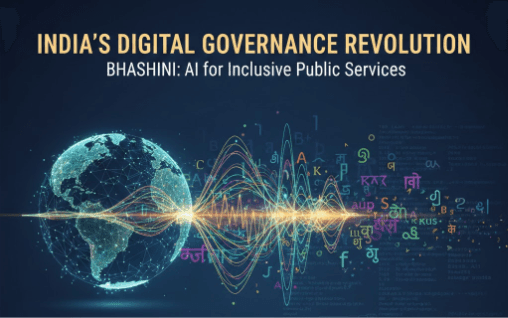
India’s push to embed artificial intelligence into public digital infrastructure is gaining momentum, with the Digital India BHASHINI Division emerging as a key enabler of language-first, inclusive governance across sectors. Two recent developments highlight how AI-driven language technologies are being operationalized both for foundational national datasets and state-level service delivery.
In January 2026, the Ministry of Electronics and Information Technology (MeitY), through its BHASHINI Division, signed a Memorandum of Understanding with the Survey of India to deploy AI-based speech and language technologies for large-scale toponymic digitisation. The collaboration aims to digitise, transcribe, and standardise geographical place names across India, supporting a validated toponymy database covering over 16 lakh locations and strengthening the National Geographical Name Information System. By leveraging AI to preserve local pronunciations, multilingual consistency, and naming accuracy, the initiative aligns closely with the objectives of the National Geospatial Policy, and is expected to enhance the reliability of national maps and digital governance platforms.
Complementing this foundational work, the BHASHINI Division also showcased its voice-first, multilingual AI platform at Uttar Pradesh’s AI Innovation and Capacity Building Conference in Lucknow. The presentation demonstrated how BHASHINI’s ecosystem, including speech-to-text, translation APIs, text-to-speech, and conversational AI tools can be deployed for inclusive, language-accessible public services. A live demonstration of Shrutlekh, alongside details of BHASHINI’s scale, 36+ text languages, 22+ voice languages, 350+ AI models, and over 500 integrations underlined its readiness for state-level adoption.
Together, these initiatives show a clear approach of using home-grown, multilingual AI to update existing national data systems while also making digital public services easier to access for people across India’s many languages.
Sources: https://www.pib.gov.in/PressReleasePage.aspx?PRID=2216760®=3&lang=1 ,
https://www.pib.gov.in/PressReleasePage.aspx?PRID=2216831®=3&lang=1
Want to Know More?
Learn more about India's data protection environment, compliance frameworks, and in-depth analyses
of privacy policies at Tsaaro.com.