


Tsaaro got CERT-IN Empanelled | MeitY has published the DPDP Rules, 2023.
Tsaaro got CERT-IN Empanelled | MeitY has published the DPDP Rules, 2023.
Tsaaro got CERT-IN Empanelled | MeitY has published the DPDP Rules, 2023.
Tsaaro got CERT-IN Empanelled | MeitY has published the DPDP Rules, 2023.

Back To Home
Research Team (Tsaaro)
The Identity Evolution: UIDAI’s Aadhaar Vision 2032 Explained

India’s Digital Identity Gets a Future-Ready Makeover
The Unique Identification Authority of India (UIDAI) issued a discreet yet significant announcement on October 30, 2025. India’s 12-digit identity system, Aadhaar, is currently enduring its most substantial technological enhancement since its inception in 2009. This is a correction to the software; it is an analysis of India’s strategies and technologies that will transform the way over a billion individuals safeguard, authenticate, and oversee their digital identities through 2032.
The initiative, designated as “Aadhaar Vision 2032”, demonstrates that UIDAI is proactively addressing potential issues rather than awaiting their emergence. Instead, it is establishing barriers around a system that processes millions of transactions daily across banking, healthcare, social welfare, and telecommunications sectors. This proactive approach warrants closer examination, as data breaches are increasingly generating headlines with the frequency of monsoons.
The Dream Team Behind the Dream
UIDAI hasn’t given this job to bureaucrats alone. Chairperson Neelkanth Mishra has instead put together a high-level Expert Committee made up of eleven experts from academia, business, and technology. This is a conscious endeavour to break down institutional silos. Dheeraj Pandey (founder of Nutanix), Vivek Raghavan (co-founder of Sarvam AI), and Rahul Matthan (a senior technology lawyer at Trilegal) are all well-known members of the committee. Also on board are big names from around the world, like Professor Anil Jain from Michigan State University (a leading voice in biometric research) and Professor Mayank Vatsa from IIT Jodhpur, as well as experts in their fields, like Professor Prabaharan Poornachandran from Amrita University, who is known for his work in cybersecurity.
This composition suggests UIDAI is serious about addressing not just today’s security challenges but also tomorrow’s threats.
What Aadhaar Vision 2032 Really Means
The roadmap depends on bringing together four disruptive technologies that sound like they came from a science fiction movie but are becoming more and more important in the actual world:
Artificial Intelligence: To find fraud and analyse behaviour
Blockchain: To check identities without being able to change them and build trust across institutions
Quantum Computing: To make cryptography that can stand up to threats from the quantum era
Advanced Encryption and Next-Generation Data Security: To protect against new cybersecurity risks that come out in the future
Why This Matters Now
The timing is on purpose. The digital economy in India is growing very quickly. In FY2024 alone, the government sent more than ₹1.5 trillion through digital channels for welfare programs, subsidies, and financial services. Aadhaar is the main part of this structure. A breach doesn’t just put people at risk; it also makes the whole digital governance system less stable.
Furthermore, worries about scalability are valid. As Aadhaar linkages grow in healthcare, financial, and IoT ecosystems, the current technological stack could become a problem. The Vision 2032 framework directly addresses this by redesigning for demand that is expected to triple in the next ten years. The framework also knows that the rules and regulations around the world are changing. UIDAI is promoting Aadhaar as not only India’s identity backbone but also as a paradigm for international interoperability. This is a step towards India’s “soft power” in setting global digital identification standards.
What Gets Built Between Now and 2032?
The Expert Committee will write the whole Aadhaar Vision 2032 paper, which will be a strategic plan that shows how to rebuild the architecture, move technologies, and meet compliance deadlines. Even though the whole paper hasn’t been made public yet, early signs point to the following areas of focus:
Resilience: Making systems that can handle both cyberattacks and old hardware
Inclusivity means making sure that Aadhaar is available to everyone, even those who are often left out, while also making sure that it is easy to use online.
Privacy by Design: Making sure that DPDP compliance is built into the core infrastructure from the start, not as an afterthought
Interoperability: Setting up systems so that banking, healthcare, and government services can all work together without any problems.
Aadhaar Vision 2032 represents India’s maturation as a digital governance power. It moves beyond treating identity as a utility to be secured and towards treating it as a fundamental digital right that must be architected with privacy, resilience, and inclusivity as non-negotiable foundations.
For a billion Indian citizens whose digital identities hang in the balance, that evolution matters profoundly.
Source
https://www.pib.gov.in/PressReleasePage.aspx?PRID=2184639
Income Tax Portal Security Flaw Revealed

When “Default Secure” Becomes a Liability
A hole in India’s Income Tax e-Filing Portal put taxpayers’ private financial information at risk. This was a wake-up warning that even basic security flaws can happen in government systems.
In September 2025, researchers found an Insecure Direct Object Reference (IDOR) flaw that was so simple that attackers only needed three things: access to the site, someone else’s PAN number, and basic technological understanding. They could get around authorisation checks by switching PANs in web requests.
What Was at Risk
Data Element | Risk Level |
Bank Account Details | Critical |
Aadhaar Numbers | Critical |
Salary & Income Records | High |
Home Addresses | High |
Email & Phone Numbers | High |
For India’s 135+ million registered taxpayers, the exposure was significant, even those who hadn’t filed returns were vulnerable.
The Timeline
September 2025: Vulnerability discovered and reported to CERT-In
October 2, 2025: Patched
October 7, 2025: TechCrunch exposed the incident
How long had the flaw existed? Neither the Income Tax Department nor CERT-In clarified.
The Irony
The tax office is also wary of audits, but for a different reason. The Cyber Cell’s audit would indicate that the system doesn’t have any basic checks for backend permission.
This tragedy is a good reminder that security theatre is worse than no security at all. IDOR vulnerabilities are not hard to understand; they are simple mistakes that well-designed systems don’t make.
What This Means
Taxpayers: If you filed your taxes before October 2, 2025, keep an eye on your bank and credit accounts for any unusual activity.
For Compliance Officers: This case will guide future DPDP Act enforcement proceedings. Regulators won’t be happy with security measures that only react to threats.
For Organisations: If India’s top tax agency missed IDOR weaknesses, you could too, unless every API call has strict authorisation validation.
Source
2: Enforcement Step-Change: New Obligations for Data Collection & Breach Notification
India’s Privacy Law Moves from Theory to Practice
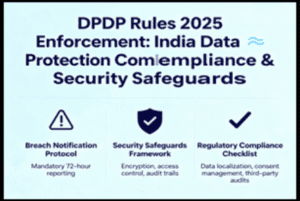
On November 13-14, 2025, India operationalized its Digital Personal Data Protection (DPDP) Act, 2023, with the comprehensive DPDP Rules, 2025. The end of the compliance grace period has arrived and penalties are real: up to ₹250 crore (~USD 28 million) for security failures.
Three Immediate Obligations
Mandatory Security Safeguards (In Force Now)
Organisations must immediately implement:
Encryption, masking, tokenization
Strict access controls with continuous logging
Tested backup systems
Third-party processor contracts with security commitments
Non-compliance penalty: ₹250 crore
72-Hour Breach Notification (In Force Now)
Upon discovering a breach:
Notify affected individuals immediately (in plain language)
Notify Data Protection Board within 72 hours
Provide nature of breach, consequences, and remedial steps
Penalty for failure: ₹200 crore
Data Minimization (Enforcement: May 12, 2027)
Organisations can collect only data necessary for the stated purpose. Users not engaged for 3 years must have data deleted (for organisations with >20M users).
What This Means
For DPOs: Audit security posture now. Map data flows. Build breach response playbooks.
For Fintechs: Breach notification obligations are active today. If you haven’t prepared, you’re behind.
For Multinationals: Cross-border data transfers now require government approval (Rule 15).
The Reality Check
A mid-sized e-commerce platform with 5M users facing a breach could incur:
Notification & investigation costs: ₹70-140 lakh
Penalty for delayed DPB notification: ₹200 crore
Compliance investment is now business-critical, not optional.
Source
https://www.pib.gov.in/PressReleasePage.aspx?PRID=2190655
3: Delhi Airport Cyberattack Probe: Aviation’s Digital Wake-Up Call

When India’s busiest airspace went to analogue, it had effects all around the country. The Automatic Message Switching System (AMSS) in Delhi, which sends out flight plans and updates, broke without warning on November 6 and 7, 2025. This made air traffic controllers go back in time to clear planes by hand and on paper. More than 900 flights were affected, 46 were cancelled, and delays stretched from Delhi to Mumbai, Bhopal, and Chandigarh. What caused it? Still being looked into. Officials The team thinks there may have been a cyberattack because they witnessed a network freeze that appeared to be deliberate digital interference. The government swiftly asked for a forensic investigation, and the results are still not in. When a software “glitch” puts national airspace at risk and makes manual clearances required, jokes about going “back to the future” get old fast.
The System That Keeps India’s Skies In Sync
The AMSS is India’s digital backbone for real-time aviation. It automates thousands of flight plans, weather messages, permissions, and diversions every hour. When it crashed, the country’s most advanced airport became shockingly weak, showing how one breakdown in important infrastructure may stop operations on a huge scale.
Ignored Warnings & Cyber Shadows
It wasn’t just an oversight. Since July, ATC officials had been warning about AMSS weaknesses and pushing for quick upgrades. The system’s “blindness”, lack of redundancy, and use of old technology all made cyber risk worse. A meeting at the National Security Advisor’s office has looked at whether this was a technical problem or something much worse. What aviation taught us: Digital transformation today can make new kinds of weaknesses, some of which are hard to see.
“Technology is the backbone of aviation—just hope your backbone doesn’t bend at rush hour!” quipped a senior ATC.
Next Steps: Getting Ready, Making Improvements, and Looking Up
Authorities are now racing to improve systems at 70 airports and add backup redundancy. Security officials are also looking at a rise in GPS spoofing events, which makes aviation cyber resilience more important across India.
Key Takeaways:
The DPDP Rules are now in effect. A 72-hour breach notification and security safeguards are mandatory, not merely future requirements. A penalty of 250 crore awaits for non-compliance.
Architecture is significant. The breaches in income tax security and the shortcomings at Delhi Airport both reveal fundamental architectural deficiencies, rather than mere superficial faults. Please conduct a prompt review of your backend access controls and redundancy mechanisms.
Aadhaar is becoming prepared for quantum computing advancements. UIDAI’s Vision 2032 establishes a new benchmark for privacy-by-design and the integration of emerging technologies. Anticipate that regulatory authorities will demand comparable rigour across multiple sectors.
India establishes its own regulations. DPDP enforcement, UIDAI’s strategic vision, and data localisation policies indicate that India will not adopt external privacy frameworks; rather, it will establish its own domestically. Align your compliance strategy accordingly.
Want to Know More?
Learn more about India’s data protection environment, compliance frameworks, and in-depth analyses of privacy policies at Tsaaro.com.